Survival
Track whether restored coral fragments remain alive following nursery and restoration activities.
Coral restoration is not only about placing corals back on the reef. Long-term restoration requires observation, documentation and learning from how corals respond over time.
Muraka Farm uses monitoring and field observations to understand restoration progress, improve our methods and build a stronger evidence base for community-led reef restoration in the Maldives.
Monitoring helps us understand what is working, where challenges appear and how restoration methods can improve over time.
Track whether restored coral fragments remain alive following nursery and restoration activities.
Document how coral fragments and colonies develop over time.
Observe visible signs of stress, damage, disease, predation and general coral condition.
Record signs of bleaching and thermal stress during monitoring activities.
Observe the condition and stability of Muraka frames and other restoration structures.
Use repeat photographs to create a visual record of restoration progress and changing reef conditions.
Restoration continues well beyond the moment coral is returned to a damaged reef area.
Restoration is an ongoing process. Monitoring continues after coral fragments leave the nursery and are transferred onto Muraka frames in damaged reef areas.
The information collected through monitoring helps guide future restoration decisions and long-term reef stewardship.
As Muraka Farm's monitoring and research programme grows, this library will provide access to restoration reports, reef assessments, monitoring summaries and other technical documentation.
 Site Assessment
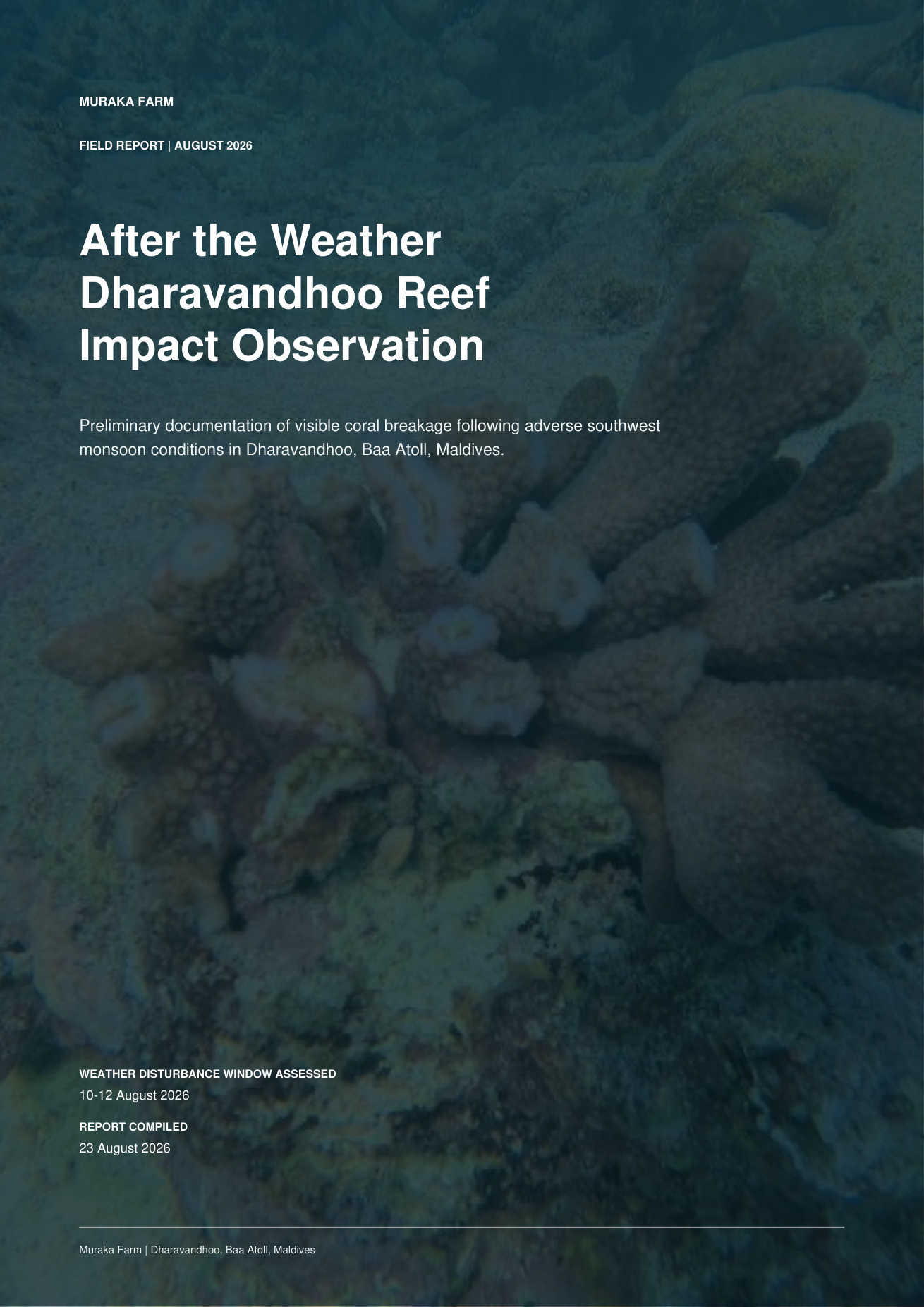
Preliminary documentation of visible coral breakage following adverse southwest monsoon conditions in Dharavandhoo. The report combines field photographs with weather and tide information and establishes a baseline for follow-up monitoring.
Muraka Farm's monitoring reports and technical documentation will be published here as they become available.
For research enquiries or requests for existing project information, contact murakafarm.mv@gmail.com.
Research with Muraka →Based in Dharavandhoo in Baa Atoll, Muraka Farm works directly within the reef environment where restoration, local livelihoods and community stewardship intersect.
Our restoration sites and community-based work can provide opportunities for researchers and students interested in coral restoration, reef ecology, environmental education and locally led conservation.
Discuss a research project →Every monitoring session adds to our understanding of how restored corals respond over time. By documenting both progress and challenges, Muraka Farm aims to strengthen restoration practice while contributing to a more transparent and locally grounded approach to reef conservation.